


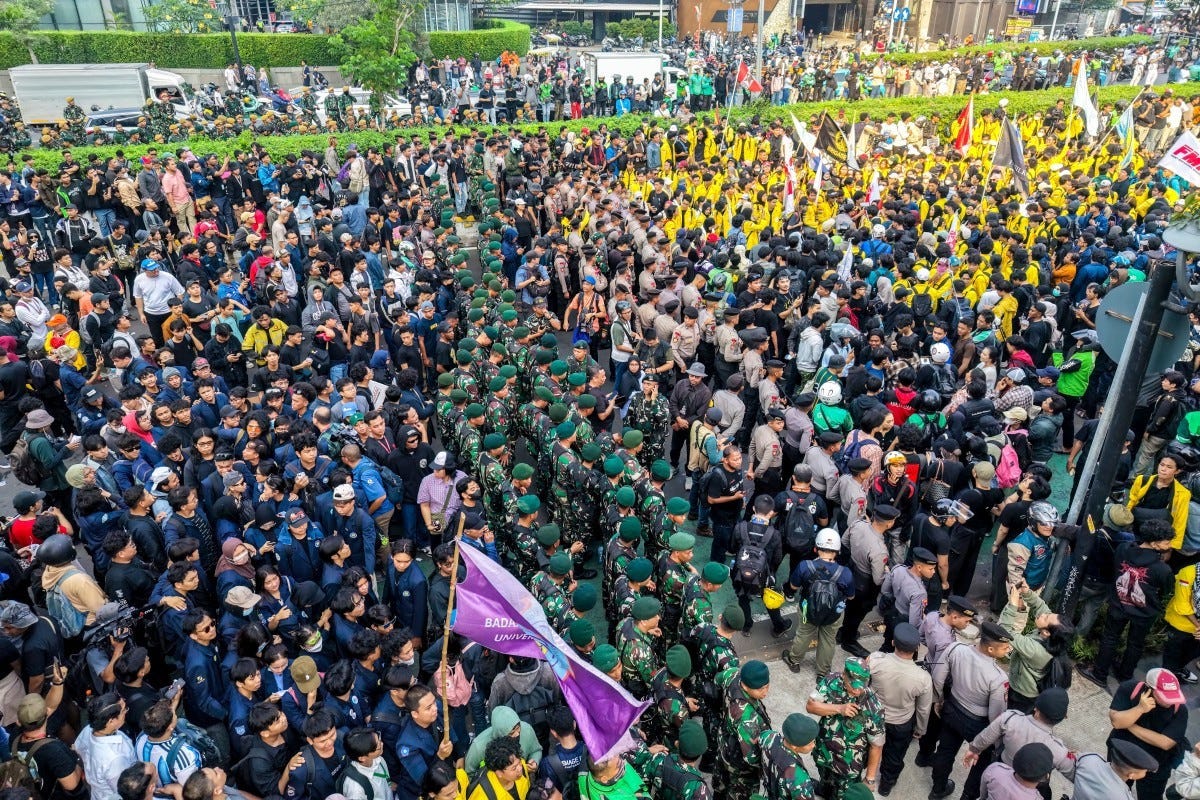
The streets of Jakarta are burning with a rage that cannot be extinguished by presidential platitudes. When hundreds of Indonesian students marched under the banner “Towards Bankrupt Indonesia” (Menuju Indonesia Bangkrut), they were not merely protesting fuel hikes or a flawed meal programme. They were declaring a generational divorce from a governing philosophy that treats citizenship as conditional upon silence.
This is not a mood swing. This is a structural revolt against a leader who tells a generation crushed by austerity that their suffering is mere “blurred vision” and their dissent “foreign interference.”
President Prabowo Subianto’s booming rhetoric—demanding “unconditional optimism” while presiding over the systematic defunding of the nation’s future—has exposed a profound and dangerous chasm between the state and its youth. The world must recognise that the “Indonesia Gelap” (Dark Indonesia) movement is not a passing squall but a political earthquake that signals the potential unravelling of Southeast Asia’s largest democracy.
At the heart of this revolt lies a brutal fiscal reality that no amount of nationalist bombast can obscure. To fund his signature Free Nutritious Meals programme—an initiative now dogged by mass poisonings and corruption allegations—Prabowo’s administration has cannibalised the nation’s future. The 2026 State Budget allocated a staggering Rp 335 trillion to the meal programme, with Rp 223 trillion clawed directly from education.
The result? Education spending has plummeted to just 14.2 per cent of total state expenditure, a flagrant violation of the constitutional mandate of 20 per cent.
This is not an accounting exercise; it is an act of generational violence. The tragedy of a ten-year-old child in Ngada, East Nusa Tenggara, who took his own life because his family could not afford notebooks and pens worth less than IDR 10,000, stands as a harrowing indictment of a state that has abandoned its most sacred duty.
As the Indonesian Civil Society Coalition declared, this tragedy is “a clear reflection of structural inequality, the fragility of the social protection net, and the weak access to education for poor families.”
Meanwhile, over 9.9 million young Indonesians—nearly one in five—are classified as NEET (Not in Education, Employment, or Training). A 21.6 per cent NEET rate against 5.11 per cent GDP growth reveals a cruel irony: macroeconomic expansion is failing to translate into quality jobs for the young. This is the structural trap that Prabowo’s rhetoric refuses to acknowledge.
When a student leader declares, “We want to show that things are not okay. We don’t want Indonesia to truly go bankrupt, but these behaviours prove that Indonesia will go bankrupt economically, democratically, and morally,” he is articulating a truth that the president seems incapable of hearing.
Prabowo’s response to this crisis has been to double down on a philosophy of conditional belonging. In a speech at the National Cooperative Day celebration on 12 July 2026, he offered a chilling ultimatum: “Those who are doubtful, please just sit at home. Those who feel that Indonesia is bleak, if you want, look for another country. Please, no one is stopping you.” This is not a rhetorical gaffe; it is a philosophical declaration that citizenship is a privilege revocable upon dissent.
This “just leave” doctrine is a weapon of class warfare. The invitation to depart is one that only the wealthy can realistically accept. For the average university student or gig-economy worker, mobility is a wall, not a door. Prabowo’s rhetoric tells a struggling generation that they have no right to complain about the house they live in—and that their presence in the nation is contingent upon the performance of optimism.
Compounding this economic and rhetorical assault is a creeping militarisation that strikes at the heart of Indonesia’s post-1998 democratic identity. The administration has expanded the military’s role in civilian affairs, deploying active personnel to implement policies from the free meals programme to food self-sufficiency initiatives.
This is a betrayal of the Reformasi spirit that swept Suharto from power. Students and civil society groups are resisting this “rhizomatic movement against militarism” with a ferocity born of historical memory. They refuse to see a resurgence of the authoritarian darkness of the New Order era.
The world has seen this playbook before. Amnesty International has documented a “growing pattern in which Indonesian authorities—including the military—deploy online disinformation to target journalists, activists, academics and protesters.” Critics are systematically branded “foreign agents,” a tactic that precedes physical violence. The acid attack that blinded rights activist Andrie Yunus is a chilling testament to the dangers of this climate of intimidation.
For global strategists, the implications are profound. Indonesia has long been the de facto leader of ASEAN. Yet a government consumed by managing internal dissent, defending a failing populist programme, and suppressing its own youth is an inward-looking power, unable to project influence or provide regional stability. As multinational corporations seek to diversify supply chains away from China, they are watching Indonesia’s internal strife with mounting alarm.
The defunding of education signals that Indonesia is willing to sacrifice long-term human capital for short-term political survival—a message that will drive investment to more stable neighbours such as Vietnam and Thailand.
The Indonesian youth are not asking for charity; they are demanding accountability. They are the generation born into the promise of Reformasi, and they refuse to be gaslit into submission. Their anger is not a problem to be managed but a warning to be heeded. The question for the international community is whether it will stand by as a democracy unravels, or whether it will raise its voice in defence of the very principles that underpin a stable and prosperous Indo-Pacific.
The darkness the students speak of is not a mirage; it is the shadow cast by a leadership that has chosen to feed its own vanity while starving its own future. The world should be watching—and it should be deeply, profoundly worried.
