


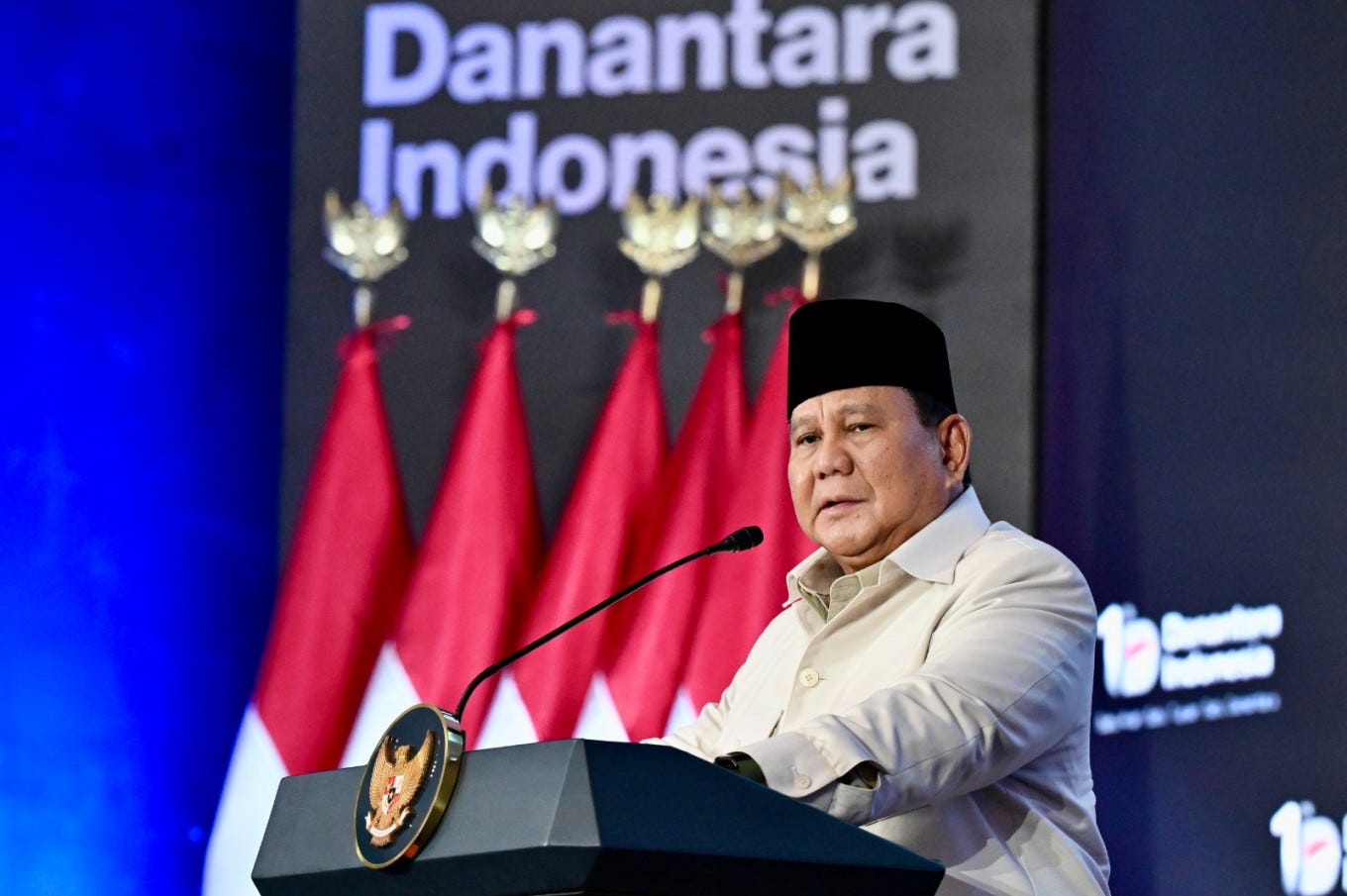
When a nation of 280 million people rewrites its financial rulebook to grant permanent legal immunity to a select class of investors, it does not merely tweak policy. It performs a constitutional act. Indonesia has done precisely that. Buried within a 207-page financial-sector law passed on 4 June is a provision that shields purchases of bonds issued by the sovereign wealth fund Danantara from criminal, civil and tax investigations.
Bond records cannot be used for tax assessments or as evidence in court proceedings. There is no sunset clause. This is not a temporary amnesty. It is a permanent legal sanctuary, encoded in statute, for money that cannot survive the light of day.
Let this sink in: the government of Southeast Asia’s largest economy has created a legally protected channel through which capital can enter without scrutiny, without accountability, without consequence. This is not financial innovation. It is the institutionalisation of impunity.
The law explicitly treats investors in Danantara’s “Patriot Bonds” and “Merah Putih Bonds” as participants in Indonesia’s tax amnesty programmes, granting them additional fiscal benefits. Yet this goes far beyond previous amnesties. Those schemes, however problematic, at least had clear timelines and rules about penalties for unpaid taxes. The Danantara immunity has no such constraints. As Achmad Sukarsono of Control Risks observed, the government “seems eager to make the product irresistible. That’s precisely the problem. It may raise funds now, but it also means that when the state needs it, legal compliance can be bent.”
The Jakarta-based Centre for Economic and Law Studies (CELIOS) condemned the provision as one that “highly accommodates the interests of political elites and financial criminals.” Nailul Huda, a CELIOS director, warned that “perpetrators of corruption and transnational money laundering who commit financial crimes could use these instruments to launder their illicit proceeds.” Indonesia’s top anti-money laundering scholar, Yenti, cautioned that the door is now open for funds from cryptocurrency, capital market crimes and tax evasion to flow into the state treasury with minimal scrutiny—a development that could “destroy Indonesia’s hard-won reputation in combating illicit funds.”
The government’s defences ring hollow. Finance Minister Purbaya Yudhi Sadewa insists that the protections apply only to funds invested in the instruments themselves, not to investors' broader business activities. “Rather than keeping money abroad, we want it to enter the domestic financial system, even if there is a slight cost,” he said.
When asked whether the law could facilitate money laundering, his response was chilling, it’s better than letting funds flow abroad. Even if there is a slight loss, we should bring funds into Indonesia’s financial system for development. If you have large amounts of money, please invest immediately.
This is not fiscal policy. This is a state extending a formal, standing invitation to capital that must never be questioned—and justifying it with the logic of desperate expediency.
Danantara is no ordinary sovereign wealth fund. It manages over US$900 billion in state assets. It operates as a super-holding company overseeing seven parent state-owned enterprises with 844 subsidiaries. It has injected US$1.4 billion into debt-laden Garuda Indonesia, provided US$295 million in loans to Krakatau Steel, invested US$7 billion in downstream projects and earmarked billions more for everything from poultry to waste-to-energy. It raised US$1.5 billion in its debut global bond issuance this month, attracting about US$4.6 billion in orders from institutional investors across the United States, Europe, the Middle East, Africa and Asia.
Yet the fund’s rapid expansion has triggered profound unease. “Danantara has strayed into areas most SWFs do not venture, and governance is still not well established,” warned Deni Friawan, a researcher at the Centre for Strategic and International Studies (CSIS). He added that “if it goes under, the cost to the state would be enormous. It’s simply too big to fail.”
The structural vulnerabilities are alarming. Public policy researcher Edi Sewandono has noted that Danantara operates “as an institution without fundamental corporate governance structures.” It lacks a board of directors, a board of commissioners, or audit and risk committees. There is no clearly defined decision-making hierarchy for investment committee responsibility, risk oversight or strategic direction. This governance vacuum creates “new vulnerabilities that could turn into serious problems.”
The power inversion within Danantara—where shareholders have override authority with presidential approval to appoint directors—“fundamentally compromises professional investment management independence.” This is not a fund. This is a parallel state in the making.
President Prabowo Subianto is leaning heavily on Danantara to finance infrastructure, strategic investments, military modernisation and flagship welfare programmes—all without breaching Indonesia’s legal 3 per cent budget-deficit ceiling. The fund has become an off-budget financing vehicle, a centralised export gatekeeper for strategic commodities including palm oil, coal and ferroalloys, and a holder of legal privileges that the Ministry of Finance itself cannot claim.
This fits a wider pattern. The government is centralising export oversight, tightening controls on export earnings and expanding military involvement in administrative affairs. As the Asia Times has noted, the administration is “building an entirely new layer of state control over trade” rather than strengthening existing institutions like the tax office, customs authority and anti-corruption bodies. The official justification—combating under-invoicing and transfer pricing—masks a deeper reality: fiscal pressure and the imperative to capture liquidity and assert control over strategic commodities at a moment of economic anxiety.
The parallels to the Suharto era are uncomfortable. During that period, the state-backed Clove Support and Trading Board—controlled by Suharto’s son Tommy—was ostensibly created to stabilise prices and protect farmers. The result was cronyism, distorted markets and widespread suffering among small producers. Today’s Indonesia has stronger institutions, but “the political temptation remains the same: When states control trade flows, access to power becomes economically priceless.”
Ratings agencies are watching. Moody’s has assigned Danantara Investment Management a Baa2 rating with a negative outlook, explicitly following Indonesia’s sovereign outlook. Fitch has given a BBB rating with a stable outlook, but the agency has already cut Indonesia’s outlook to negative due to “weaker policy credibility and transparency issues.” S&P Global has assigned a “BBB” long-term issuer rating. These ratings, however, rest on an assumption of government support.
If Danantara becomes associated with undeclared wealth, politically protected capital and opaque flows, that support—and Indonesia’s entire sovereign risk profile—becomes contaminated.
The mechanism is insidious. Every basis-point increase in Indonesia’s sovereign yield curve translates into higher interest payments on government debt, reduced fiscal space for healthcare and education, and higher capital costs for Indonesian corporations. The burden of Danantara’s impunity is thus socialised across 280 million citizens, while the benefits accrue to a narrow circle of politically connected bond buyers and the executive branch that accesses off-budget funds. This is a regressive fiscal transfer of immense proportions, executed not through a line-item in the budget but through the subtle, punishing arithmetic of global bond markets.
What remains of democratic fiscal consent when the most consequential financial decisions migrate to a legally insulated shadow budget? The answer is: very little. Parliament debates and approves a formal budget that no longer represents the totality of state financial commitments. The most consequential decisions—which strategic investments to pursue, which military systems to modernise, which welfare programmes to expand—are effectively made within the executive, financed through Danantara’s shadow budget and shielded from legislative scrutiny by the very immunities that make the bonds attractive.
This is a soft constitutional coup against the legislature, executed through financial engineering rather than tanks. The parallel treasury exists precisely because the executive seeks to escape the transactional costs of democratic consent: the need to negotiate, compromise and publicly justify trade-offs. By relocating fiscal action to a legally insulated entity, the government can pursue its agenda with the speed and decisiveness of an authoritarian regime while maintaining the procedural facade of democratic budgeting.
The Danantara bond immunity law is a bet—a bet that the short-term benefits of mobilising hidden capital outweigh the long-term costs of governance erosion, reputational damage and democratic decay. It is a bet that global investors will continue to look past the institutionalisation of impunity. It is a bet that the Financial Action Task Force will not place Indonesia on its grey list.
These are dangerous bets. As Rahma Gafmi, an economics professor from Airlangga University, warned, detailed implementing regulations are needed to “serve as a legal brake to ensure this extreme incentive does not go out of control and become the mass facilitation of illegal money laundering.”
But the problem runs deeper than regulation. When a sovereign wealth fund becomes a parallel state—when it operates outside the budget, beyond parliamentary control and above the law—the line between statecraft and state capture collapses. The republic begins to resemble a system where legality is optional, transparency is performative, and sovereignty itself is mortgaged to hidden capital.
Indonesia has not created a financial innovation. It has built a sanctuary for money that cannot survive daylight. And in doing so, it has placed its democratic institutions, its creditworthiness and its international reputation on a path toward slow, corrosive decline. The world is watching. The markets are watching. And the cost of this experiment will be borne not by the politically connected few who purchase these bonds, but by the 280 million citizens whose future is being mortgaged to opacity.
