


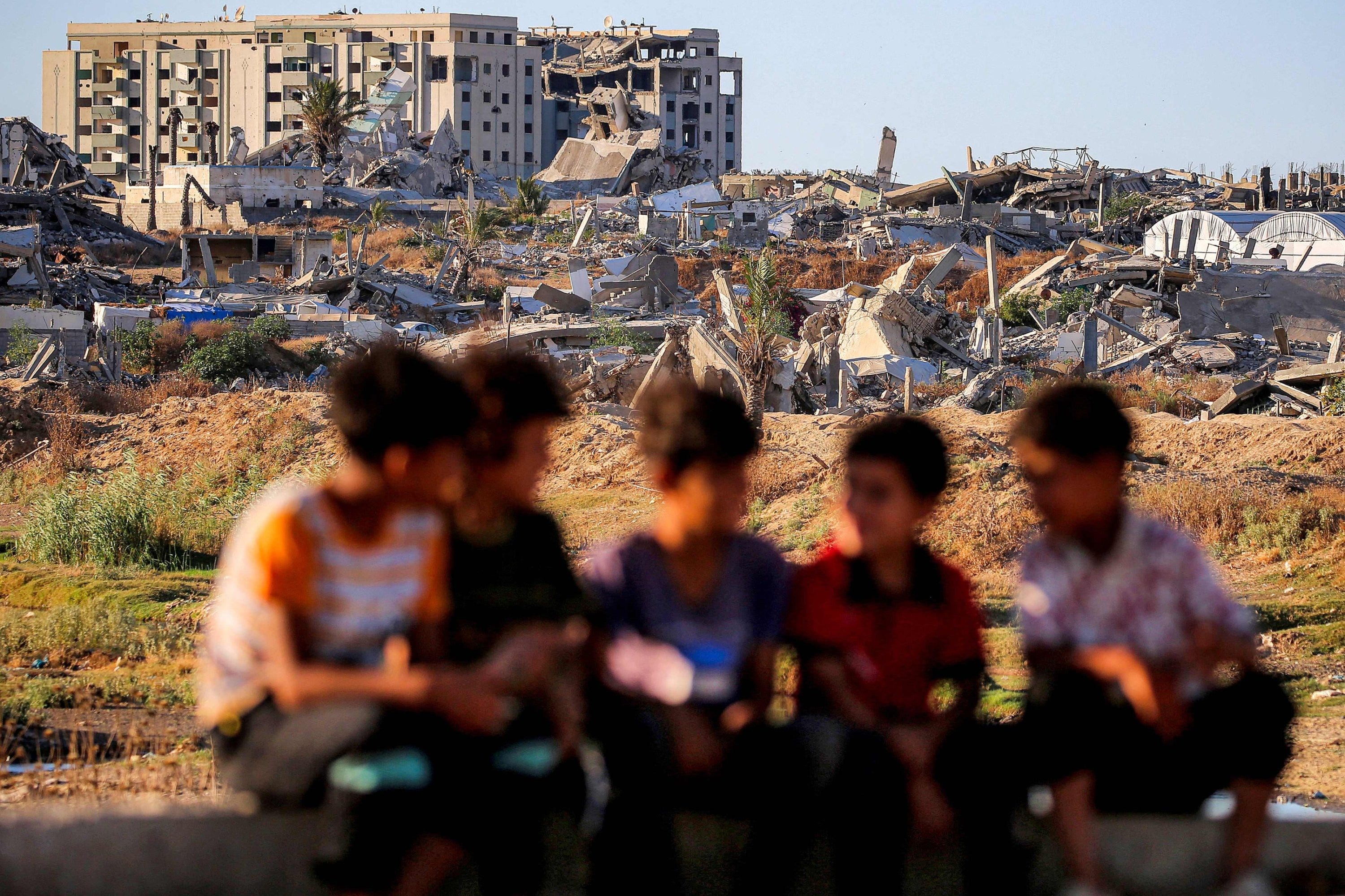
On 23 June, the United Nations Independent International Commission of Inquiry on the Occupied Palestinian Territory, including East Jerusalem, and Israel released one of the most devastating reports ever produced by a UN investigative body on the Israeli genocide in Gaza. Its title is almost unbearable to read: The Essence of Childhood Has Been Destroyed. Behind the title lies an accusation of extraordinary gravity. The Commission concludes that Israeli authorities and security forces have deliberately targeted Palestinian children and that these actions amount to genocide, crimes against humanity, and war crimes in the Gaza Strip, alongside war crimes in the occupied West Bank.
The report is not an emotional appeal. It is a painstaking legal document built upon witness testimony, forensic evidence, satellite imagery, military analysis, medical records, and years of documentation. What it presents is not merely another catalogue of civilian casualties. It argues that the killing, maiming, starvation, detention and psychological destruction of Palestinian children cannot be explained as collateral damage. Rather, the Commission concludes that children themselves have become deliberate targets of Israeli military policy. The implications of such a finding reach far beyond Gaza. They raise fundamental questions about the future of international law itself.
A Report of Extraordinary Gravity
The Commission estimates that since October 2023, at least 20,179 Palestinian children have been killed and more than 44,000 injured. Approximately thirty per cent of all Palestinians killed have been children. These figures alone place the Gaza war among the deadliest conflicts for children in modern history. Yet the report’s importance lies not simply in the numbers but in its conclusions regarding intent.
It documents repeated instances in which children were shot by snipers, attacked by drones, struck while seeking food or water, or killed despite posing no military threat—as should have been obvious. It examines the repeated use of high-yield explosives in densely populated civilian areas long after the predictable consequences for children had become undeniable. It details attacks on maternity hospitals, neonatal wards, schools, orphanages and shelters. It also examines the blockade of food, water and medicine, showing how starvation, disease and the collapse of medical services have become instruments of war directed against an entire civilian population whose youngest members are the most vulnerable.
The Commission investigates Israeli detention practices involving Palestinian minors. Children arrested in Gaza and the West Bank describe torture, sexual violence, degrading treatment and disappearance into detention facilities without information being provided to their families. Such abuses, the report concludes, form part of a broader system of collective punishment directed against Palestinian society across generations. The UN Commission report is not novel on this, even though the findings are devastating. They corroborate previous reports by Save the Children (Palestinian Children in Israeli Military Detention Report Increasingly Violent Conditions, 29 February 2024) and, long before this genocidal campaign that began in 2023 by UNICEF (Children in Israeli Military Detention, February 2013). In his recent book, Survivors of the Darkness, the Palestinian journalist Wesam Afifa documents the horrendous violence of the Israeli concentration camps set up for Palestinians, including children.
Perhaps the UN report’s most chilling conclusion is that the destruction extends beyond physical death. Childhood itself has become a battlefield. Psychological trauma, orphanhood, repeated displacement, hunger, interrupted education and permanent disability together amount to what the Commission describes as the destruction of “the essence of childhood.”
A Pattern Long Documented
The Commission’s findings did not emerge suddenly. For nearly two years, Palestinian journalists have documented children pulled from collapsed buildings, infants dying in incubators without electricity, families wiped out in airstrikes and children shot while attempting to retrieve food or water. Many of those journalists paid with their own lives. Gaza has become the “deadliest conflict ever for journalists,” reported Irene Khan, the UN Special Rapporteur on the promotion and protection of the right to freedom of opinion and expression. Yet, despite extraordinary danger the journalists continued documenting events that much of the world preferred not to see.
International human rights organisations reached similar conclusions long before this recent UN report. Save the Children repeatedly warned that Gaza had become one of the most dangerous places on earth to be a child. Defence for Children International—Palestine documented repeated shootings of children in circumstances that raised serious questions about military necessity. Human Rights Watch investigated attacks on schools, hospitals and refugee camps. Amnesty International examined repeated strikes that appeared to violate the principles of distinction and proportionality under international humanitarian law. UNICEF repeatedly warned that children were being killed and injured on an unprecedented scale. None of these organisations described isolated accidents. They identified recurring patterns that demanded independent investigation. The new UN report effectively consolidates this vast body of evidence into a single legal assessment.
In January 2024, the International Court of Justice found that South Africa’s case alleging genocide by Israel was plausible and ordered provisional measures requiring Israel to prevent acts prohibited under the Genocide Convention, preserve evidence, and facilitate humanitarian assistance. Subsequent orders strengthened these requirements as conditions in Gaza deteriorated. Although the Court has not yet ruled on the merits of the genocide case, it has repeatedly recognised the grave risk faced by the Palestinian population and the continuing obligations imposed upon Israel under international law. The new Commission report provides further evidentiary material that will inevitably shape future legal proceedings.
The Silence of the Israeli State
Perhaps equally striking has been the nature of Israel’s response. Rather than seriously engaging with the evidence assembled by the Commission, Israeli officials once again dismissed the report outright, describing it as politically motivated and fundamentally biased. They rejected its conclusions in their entirety without offering substantive rebuttal of the specific incidents, witness testimony, or forensic evidence presented by investigators. Every state has the right to defend itself against allegations. But serious allegations require serious answers.
If children were not deliberately targeted, the burden rests upon the Israeli authorities to explain why thousands of children have died in circumstances repeatedly documented by journalists, humanitarian organisations, medical personnel, and now a UN Commission of Inquiry. Why have hospitals, maternity wards, schools and refugee shelters been struck again and again? Why have humanitarian convoys repeatedly come under attack? Why have children continued to die even after ceasefire arrangements? Why have military investigations produced so little accountability? Simply repeating accusations of institutional bias cannot substitute for factual explanation. The refusal to engage with evidence has itself become a disturbing feature of this war.
International humanitarian law rests upon the principle that states are accountable for their conduct. Accountability becomes impossible when every investigation is dismissed before its evidence is even examined.
Justice S. Muralidhar and the Duty of the Judge
The findings of the UN Commission also remind us of the importance of judges who understand that the law is not merely a technical instrument but a defence against arbitrary power. Few Indian judges have embodied that principle more consistently than Justice S. Muralidhar, who as UN Commission on Human Rights, chaired this new report’s committee.
Justice Muralidhar earned a reputation over decades as one of India’s most respected constitutional jurists, particularly in cases involving civil liberties, communal violence, and the protection of vulnerable communities. He was one of the principal judicial voices in implementing accountability after the 1984 anti-Sikh pogrom, insisting that impunity could not become the norm merely because the crimes were politically inconvenient. His commitment to constitutional duty became internationally known during the communal violence in northeast Delhi in February 2020. As hospitals struggled to treat victims trapped by the violence, Justice Muralidhar and Justice Anup J. Bhambhani convened an extraordinary midnight hearing at Justice Muralidhar’s residence. The Delhi High Court ordered the police to ensure the safe passage of the injured to hospitals and directed immediate emergency medical treatment. Later that day, Justice Muralidhar sharply questioned the failure of the Delhi Police to register cases against political leaders whose inflammatory speeches had been widely circulated, reminding the authorities that the country could not permit “another 1984.”
Within hours of these hearings, the Government of India notified Justice Muralidhar’s transfer to the Punjab and Haryana High Court, although the recommendation for his transfer had formally been made by the Supreme Court Collegium earlier that month. The timing generated widespread concern among lawyers, retired judges, and civil society organisations, who regarded the episode as raising troubling questions about judicial independence.
Justice Muralidhar’s career illustrates an essential principle of the rule of law. Courts do not exist to ratify the conduct of governments. Their function is to examine evidence without fear or favour, especially when the victims are those with the least political power. The same principle animates the work of the UN Commission of Inquiry. Its conclusions may be contested, but they cannot simply be dismissed because they are politically inconvenient. The proper response to serious evidence is serious engagement. That is the first obligation of any state that claims to respect the rule of law.
The Test Before Humanity
The UN Commission’s report is ultimately not only about Israel or Palestine.
It asks whether the international legal order created after the defeat of European fascism still possesses the moral authority to defend children from organised violence. If more than 20,000 children can be killed while the institutions of international diplomacy continue largely as normal, then the promise embodied in the Genocide Convention, the Geneva Conventions, and the Convention on the Rights of the Child stands gravely diminished. The report will not end the war. It cannot restore the lives already lost. But it establishes a historical record that will become increasingly difficult to erase. Long after governments change and military campaigns conclude, this record will remain. History remembers those who committed atrocities. It also remembers those who looked away.

Friends and relations wonder why I keep protesting against the "defence" of Israel from Gaza and Lebanon by the Israel government and the IDF. Quite apart from the genocides being perpetrated, surely you'd expect a retired paediatrician to be incensed at the facts revealed in this ghastly story by V. Prashad. My sincere thanks to him.
"IT'S NOT COMPLICATED
~ IT'S GENOCIDE" is what is printed on the placard I've carried in "FOPs" rallies in Australia since the massacre began in 2023. No dressing as a Dandy but Friends Of Palestine is FOP.