


Washington spent decades disciplining China with tariffs, sanctions, export bans, lectures, and the moral theatre of strategic superiority. Beijing was cast as the perpetual rule-breaker—too mercantilist, too authoritarian, too ambitious, too Chinese. Every aircraft order was scrutinised as leverage, every semiconductor shipment treated as a national security threat, every barrel of Iranian oil turned into evidence of geopolitical sin.
From the late 1980s to the 2020s, the United States built an entire architecture of punishment around China: hundreds of firms blacklisted, advanced chips blocked, tariffs on hundreds of billions of dollars in goods, and repeated sanctions on Chinese entities over Iran, Russia, Xinjiang, fentanyl, and beyond.
And now, with President Donald Trump returning to Beijing in May 2026 for the first visit by a sitting US president in nearly nine years, the theatre has changed. The language is softer. The handshakes are warmer. Boeing wants orders. Wall Street wants calm. Silicon Valley wants access. Washington, suddenly, wants mateship.
This is not reconciliation. It is recognition.
For years, American strategy assumed China could be constrained into submission—technologically isolated, financially pressured, strategically boxed in. Yet China did not collapse. It adapted. It industrialised faster. It deepened its supply chains. It built alternatives. It became not merely a rival to the United States, but one of the two engines of the global economy.
China now produces roughly 30 per cent of global manufacturing output, up from just 6 per cent in 2000, with projections suggesting it could approach 45 per cent by 2030. The United States, by contrast, may fall to around 11 per cent. China controls 60—70 per cent of global rare earth output and nearly 90 per cent of processing capacity—the quiet monopoly behind electric vehicles, wind turbines, missiles, and smartphones. The US still imports around 70 per cent of its rare earths from China. This is not dependency theory. This is a strategic fact.
The International Monetary Fund projects that China and India together will account for roughly 43—44 per cent of global GDP growth between 2026 and 2030. China alone contributes around 26.6 per cent; the United States, just under 10 per cent. Germany’s largest trading partner is now China, not America. Across Africa, Southeast Asia, Latin America, and the Gulf, the world increasingly trades east before it looks west.
This is why Trump arrived in Beijing not with a sermon, but with CEOs. Elon Musk. Tim Cook. Boeing executives. Finance chiefs from Goldman Sachs and BlackRock. Not democracy evangelists. Not strategic romantics. Merchants of realism.
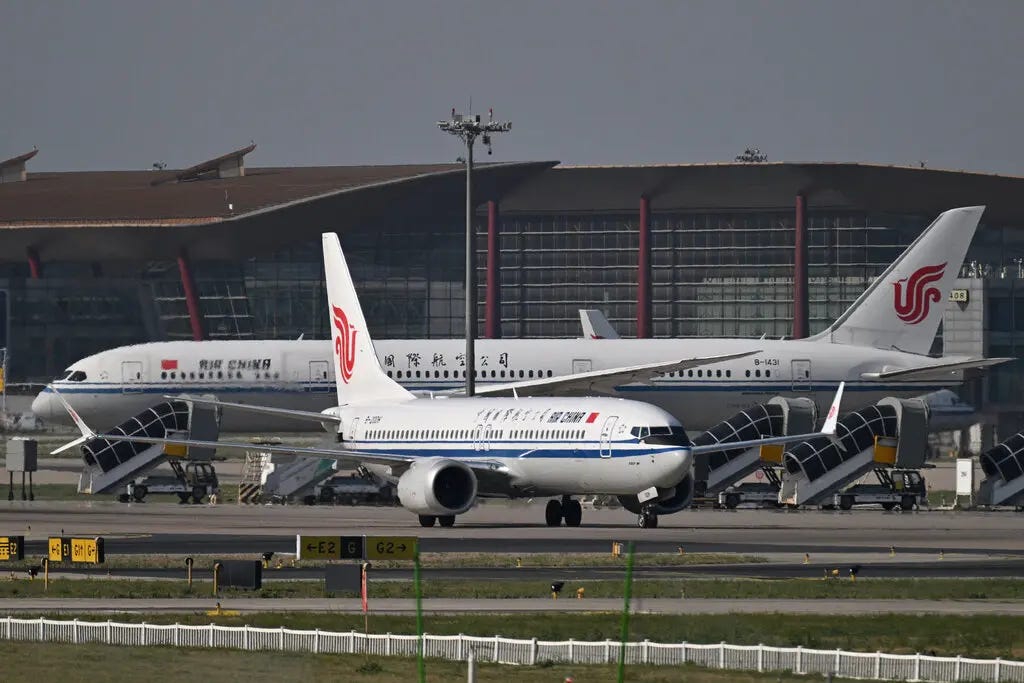
Boeing reportedly seeks a mega-order of around 500 737 MAX aircraft and another 100 widebody jets after a nine-year drought. American farmers want renewed Chinese purchases of corn, wheat, beef, poultry, and soybeans. Washington wants a formal “Board of Trade” and investment forum to stabilise disputes. The October 2025 trade truce is expected to be extended because both economies are exhausted by tariff warfare.
This is not the collapse of democratic values. It is the triumph of national interest over ideological vanity. Even the semiconductor war shows the same truth. In December 2024, Washington tightened export controls to block China’s access to advanced AI chips and semiconductor tools, explicitly aiming to impair China’s indigenous chip ecosystem “at the expense of US national security.” Yet by early 2026, the United States quietly approved Nvidia’s H200 AI chip exports to China under conditions. Because even empires discover that markets have a vote.
China, meanwhile, did not wait for Western permission. It expanded the Cross-Border Interbank Payment System, accelerated digital yuan diplomacy, and openly pushed for a “multi-polar currency system.” The US dollar still dominates global reserves at around 58 per cent, while the renminbi remains small. But the symbolism matters. Beijing is building not merely resilience, but optionality.
Nothing exposed American strategic contradiction more sharply than Iran. Washington sanctioned Chinese firms for helping Iran’s weapons programs and oil exports. Treasury blacklisted entities in China and Hong Kong, vowing to cut Tehran off from financial networks. Yet in the same breath, Trump reportedly considered easing sanctions on Chinese companies buying Iranian oil if Beijing helped stabilise the Strait of Hormuz.
Punishment became negotiation. Principle became transaction. Beijing’s response was equally revealing. China denounced the sanctions as illegal and unilateral and, for the first time, formally invoked its Anti-Foreign Sanctions Law, ordering Chinese firms to ignore US penalties on several petrochemical refineries. This was not merely defiance. It was legal counter-sovereignty.
A line had been crossed: multinational firms were now trapped between two competing empires of law. This is the true story of the 2026 summit. Not friendship. Non détente. Mutual indispensability.
Taiwan remains the sharpest edge. Xi Jinping will not soften on sovereignty. “There is but one China,” Beijing repeats with ritual certainty. Washington will preserve strategic ambiguity because abandoning Taiwan would shatter alliances across Asia. No grand bargain is coming.
Rare earths remain weaponised. AI remains a battlefield disguised as cooperation. Iran remains a sanctions chessboard. Trust remains thin. But something deeper has changed: the United States now knows China cannot be humiliated into obedience.
For too long, Washington treated engagement as charity—as though access to the American market was a civilising gift bestowed upon Beijing. It forgot that globalisation changed both sides. Apple needs China. Tesla needs China. Boeing needs China. So do global inflation targets, climate transitions, and semiconductor stability.
The old assumption—that China needed America more than America needed China—is now intellectually bankrupt.
The lesson for the Global North and the Global South is no longer about choosing sides between Washington and Beijing; it is about surviving the consequences when giants choose confrontation over coexistence. From Jakarta to Johannesburg, from Brasília to Brussels, from Nairobi to New Delhi, nations live in the shadow of this rivalry—not as spectators, but as economies, societies, and futures directly shaped by its tremors.
When tariffs rise in Washington, factories close in Vietnam. When rare earth exports tighten in Beijing, energy transitions stall in Africa and Europe alike. When Taiwan Strait tensions escalate, global semiconductor arteries seize, and every nation pays the price in inflation, insecurity, and instability. The world does not need another Cold War dressed in digital language. It needs diplomatic maturity. It needs strategic restraint. It needs great powers to remember that prestige is not policy, and humiliation is not strategy.
Sovereignty cannot be defended by permanent hostility, and prosperity cannot be built on endless punishment. The Global South especially, has grown weary of being treated as an audience for ideological contests scripted elsewhere. It seeks roads, ports, food security, energy access, climate justice, and dignity—not lectures packaged as alliances.
This is why Washington’s return to Beijing carries meaning far beyond bilateral diplomacy. It is not generosity; it is the quiet recognition of strategic limits. It is the admission that sanctions alone cannot govern a world where China produces nearly a third of global manufacturing, drives over a quarter of global growth, and sits at the centre of supply chains that power modern civilisation. It is the understanding that no nation, however powerful, can firewall itself from interdependence.
The future of diplomatic sustainability will not be written through containment, but through coexistence—difficult, imperfect, and often frustrating coexistence.
The task before global policymakers is not to romanticise either power, but to build rules stronger than rivalry itself: institutions that outlive presidents, economic frameworks that reduce coercion, and security architectures that prevent miscalculation from becoming catastrophe. History will not remember who shouted loudest about dominance; it will remember who dared to preserve stability when pride demanded confrontation. In that truth lies the real test of leadership for both North and South alike.
Great powers rarely apologise. They recalibrate. America disgraced China for decades—sanction by sanction, tariff by tariff, lecture by lecture—assuming history would bend obediently toward American primacy. Instead, history bent toward interdependence.
Now, in Beijing, the disgracer returns asking for trade boards, aircraft deals, AI cooperation, and strategic calm. Not because values changed. Because power did. And in international relations, power is the most honest language of all.
