


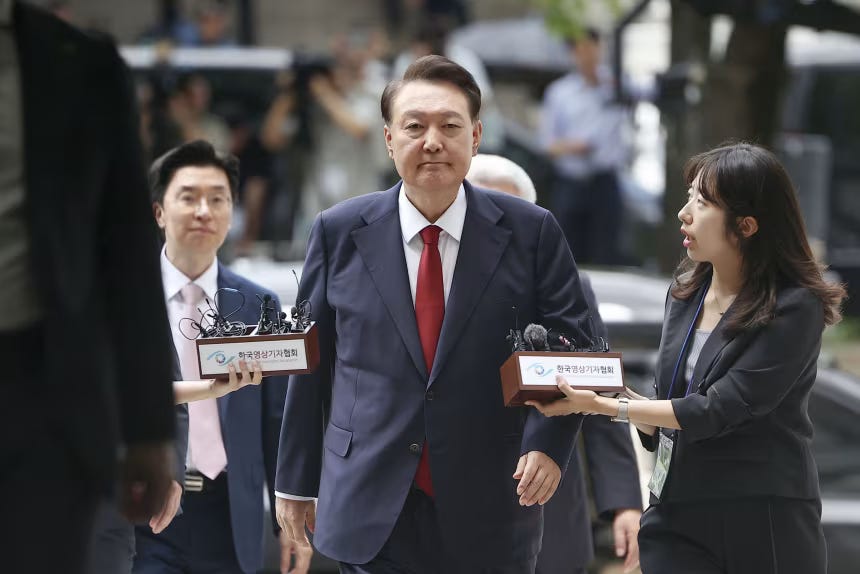
Former South Korean president Yoon Suk Yeol was sentenced to life imprisonment on Thursday 19 February, after a court found him leading an “insurrection” by declaring martial law in December 2024.
The declaration of martial law violated the authority of South Korea’s National Assembly, the Seoul district court observed, calling it an insurrection undermining the constitutional order in the country, The Korean Times reported.
Former prime minister Han Duck Soo, defense minister Kim Yong-hyun along with several former military and police officers, involved in the justification or execution of the martial law decree at the time, were also found guilty by the court and sentenced to similar terms in jail as Yoon.
The disgraced former president’s act damaged government institutions and the reputation of the country abroad, the court argued, observing that the act made the police and military lose much of their political neutrality.
The deployment of troops to the National Assembly amounted to the use of force against a constitutional body and was the core factual element of the case against Yoon, the verdict says.
In Korean law, for attempting to lead an insurrection one can be either given a death sentence or life imprisonment with or without labor. Yoon was sentenced to life imprisonment with labor.
The court argued that the quantum of punishment against Yoon was based on the fact that insurrection was not found to be planned and there was negligible use of physical violence. The court also considered Yoon’s lack of criminal record.
This was for the second time in South Korea’s history when a former president was awarded life sentence for attempting a coup. In 1996, former president and military dictator Chun Doo-hwan was given a death sentence which was later converted to life imprisonment.
Yoon’s swing and miss
Highly unpopular and hawkish leader of the Peoples Power Party (PPP), Yoon (65), declared martial law on 3 December 2024, following parliament’s refusal to approve his government’s budget proposals.
Ever since his election in 2022 he had implemented policies creating open hostility with North Korea and building a close military alliance with the US.
He had tried to suppress the opposition by accusing them of disrupting constitutional order and democracy in the country. Yoon had tried to justify his coup attempt by claiming that marital law would help him in his attempts to eradicate “shameless pro-North Korean anti-state forces.”
However, massive popular mobilizations in the streets of Seoul and other major cities forced Yoon to withdraw the martial law hours after its declaration.
The same popular pressure forced the National Assembly to vote against Yoon’s measure and declare it illegal.
Later, Yoon was impeached on 14 December and all his powers were removed by the parliament. He refused to resign and was finally removed from his post by the constitutional court on 4 April.
He became the second president (after Park Geun Hye, 2017) to be removed from the post after a ruling by the constitutional court.
The quantum of punishment invited a mixed reaction from the people, with the ruling Democratic Party (DP) demanding harsher punishment and calling Yoon’s life sentence very inadequate.
“This is a judgement that turned its back on the people who stood up against emergency martial law and a clear setback for the people’s revolution of light,” DP leader Jung Chung Rae told the press.
Amnesty International, however, welcomed the judgment, claiming it establishes there is no one above the law in South Korea.

I'd like to know where the US/CIA was with Yeol, and his extreme anti-North Korea aiming for what: all out war, or color revolution albeit most of the masses were against his policies.
Otherwise, some positive news in this worldwind of evil times.
Ron Ridenour