


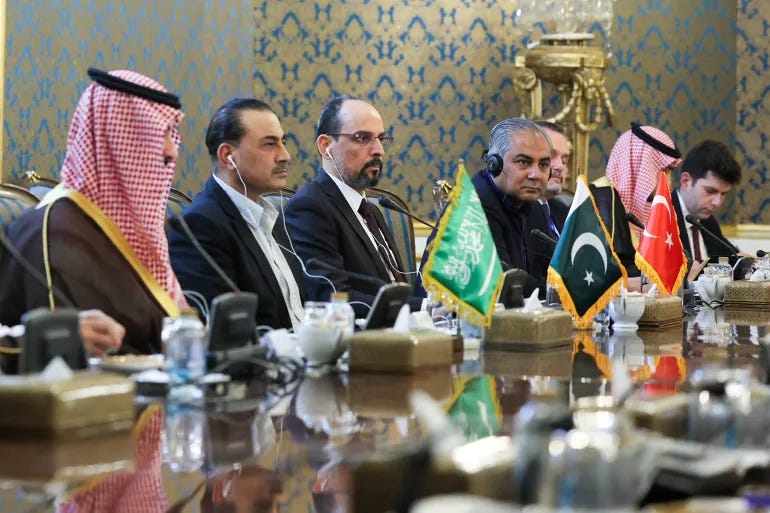
The Mecca Joint Defence Agreement and the Badr Memorandum of Understanding are being sold to the world as a rupture—a defiant break from the old order of superpower patronage, a blueprint for a sovereign Global South. That is a seductive story. It is also a dangerous half-truth.
What Saudi Arabia, Türkiye, and Pakistan signed in August 2026, and what Türkiye, Qatar, Pakistan, and Indonesia sealed in Doha that October, is not a philosophical departure from Ankara’s interwar and Cold War playbook. It is that playbook, executed with colder calculation and far higher stakes. The Mecca–Badr architecture is a sharp escalation of Türkiye’s instrumental alliance logic, not a repudiation of it.
The historical rhyme is unmistakable. The Saadabad Pact of 1937 was a juridically thin instrument—consultative, non-binding in extremity—designed to freeze frontiers and keep the fires of a collapsing order away from the Turkish core. The Mecca Pact is its juridically thick successor: a ten-year lock-in, a standing secretariat in Riyadh, and an Article 5-style pledge that an attack on one is an attack on all. The form has changed. The purpose has not.
Ankara still trades external guarantees for endogenous state-building—industrial deepening, military modernisation, the consolidation of sovereignty. The only difference is that the guarantor portfolio is now diversified. Washington is no longer the sole underwriter. Riyadh, Islamabad, and Doha have joined the syndicate.
But here is the brutal irony that the celebrants of “strategic autonomy” refuse to confront. Türkiye supplies the conventional backbone and the defence-industrial teeth—NATO’s second-largest army, a defence export machine that reached $10.54 billion in 2025, and Baykar’s battle-proven drones that have rewritten the economics of modern war.
Yet the institutional architecture of Mecca tells a different story. The secretariat sits in Riyadh. The first secretary-general is a retired Pakistani lieutenant general. Ankara buys influence without command. It furnishes the capabilities but not the operational levers. This is a division of labour that flatters Turkish power while quietly subordinating its preferences to Gulf and Pakistani priorities.
The rapid activation of Mecca in October 2026, in response to Houthi drone and missile strikes, was presented as proof of resolve. It was proof of something else: that the pact’s deterrent threshold is dangerously low. By treating a sub-strategic proxy attack as an Article 5 event, the alliance has signalled that its escalatory bar is permanently lowered—an invitation to persistent, low-intensity probing rather than a credible deterrent against existential threats.
And the ten-year lock-in imports entrapment on a grand scale. A Houthi escalation can drag Türkiye into a Gulf war it would not otherwise choose. A Pakistan–India crisis can activate Mecca in ways Ankara cannot control. The credibility gain is uncertain; the entrapment cost is structural and foreseeable.
Badr compounds the problem. The industrial MoU gives Türkiye export markets and co-production reach, but it splits the beneficiaries from the obligors. Qatar and Indonesia reap technology transfers and supply-chain integration without bearing Mecca’s collective-defence burdens. This is a free-rider equilibrium dressed up as an industrial ecosystem. Worse, it creates a dual-market trap that Turkish strategists have not begun to price.
NATO interoperability demands STANAG standards, secure communications protocols, and predictable export controls. Bespoke Global South supply chains demand the opposite: speed, flexibility, and a willingness to sell to buyers the West will not touch. Ankara is trying to be both the world’s most unconstrained drone merchant and a trusted NATO industrial partner.
Those paths are diverging sharply, and the hidden costs—duplicated certification, fragmented production lines, and the slow erosion of Western trust—are the single greatest economic vulnerability of the Badr model.
The strategic ambiguity that Ankara calls “ambidexterity” is better read as soft balancing against the United States, not mere hedging. The Mecca–Badr architecture is a soft-balancing instrument: it aims to constrain Washington’s freedom of action by building alternatives insulated from Western embargoes and political conditions. But the veto paradox cuts both ways.
Türkiye’s NATO membership gives it a procedural veto, yet the credibility of that veto depends on the cost of isolation. The more credible Mecca–Badr becomes, the less indispensable NATO appears—and the less credible Ankara’s threat to obstruct or exit becomes. The construction of alternatives does not enhance Turkish leverage inside the Alliance. It discounts it.
And what of the normative claim that this architecture preserves “absolute national sovereignty”? It does not. Co-owning intellectual property and integrating supply chains creates new forms of interdependence that are themselves a species of domination. If Türkiye controls the cryptographic verification infrastructure for shared weapon systems, it exercises a de facto veto over its partners’ ability to modify their own defences.
If Saudi capital becomes indispensable to the industrial ecosystem, the weaker partners are exposed to Riyadh’s arbitrary power. The Mecca–Badr model does not escape domination. It redistributes arbitrary power from Washington to Ankara, Riyadh, and Islamabad, while claiming to have transcended it altogether.
The strategic lesson is not that the Mecca–Badr architecture is a blueprint to be copied or a monolith to be feared. It is a transitional form—flexible, brittle, and suspended between the old world of hegemonic guarantees and an unsettled multiplex order whose institutional logic remains unresolved. It is neither a rupture nor a rebranding. It is Türkiye’s old instrumental logic, sharpened to a razor’s edge and pointed at Washington, Riyadh, and Islamabad.
The danger is not that it will succeed. The danger is that it will half-succeed—generating enough ambiguity to deter no one, enough entanglement to trap everyone, and enough illusion to obscure the fact that the old game of trading guarantees for state-building has simply acquired new, more volatile counterparties.