


On 23 July 2026, before the assembled faithful of the National Awakening Party in Jakarta, the president of the world’s fourth-most-populous nation resurrected a ghost. Londo ireng—“black Dutchman”—was the colonial era’s most contemptuous slur for indigenous Indonesians who joined Dutch forces to fight against their own revolution.
And President Prabowo Subianto deployed it against journalists, political analysts and non-governmental organisations. “Londo-londo ireng ini sampai sekarang masih ada (Those black Dutchmen, they still exist),” he declared, “only now they wear different clothes: journalists, observers, NGOs.”
This was no slip of the tongue. It was a structural warning shot. The phrase carries a weight that Western observers struggle to grasp. During the Indonesian National Revolution of 1945—1949, londo ireng was the ultimate mark of betrayal—an ontological condemnation that placed the collaborator beyond the pale of national community.
Prabowo has accomplished something fundamentally dangerous by applying this colonial binary to the modern democratic landscape: he has transformed civic scrutiny into treason, factual reporting into subversion, and constitutional critique into foreign conspiracy.
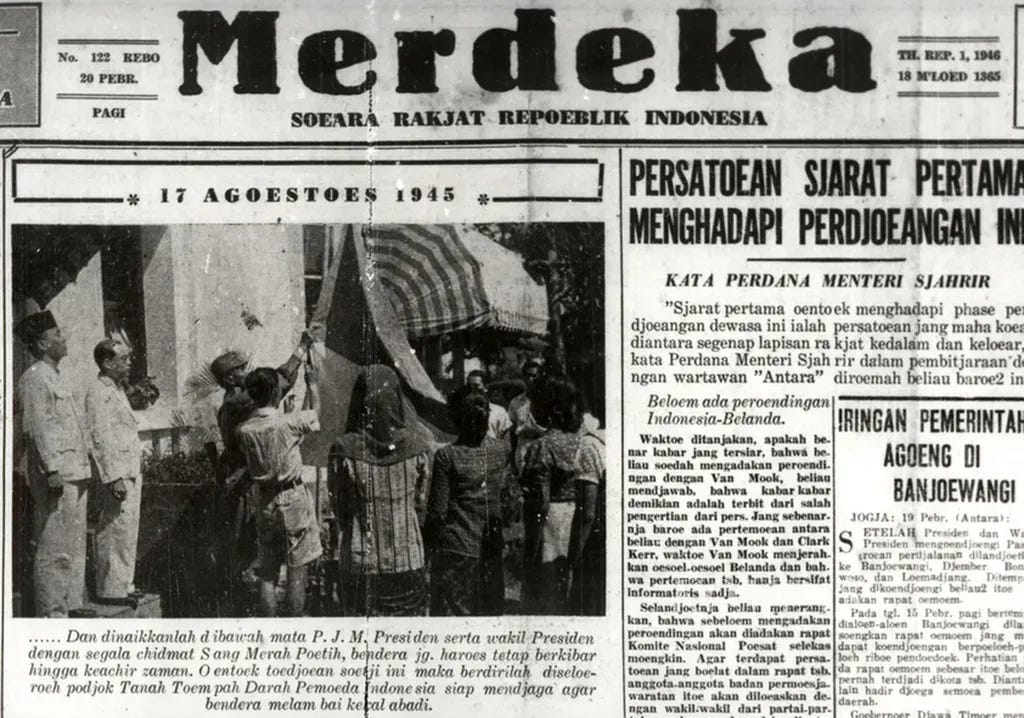
The irony is as breathtaking as it is tragic. The independent press that Prabowo now casts as a colonial army was, in fact, the architect of Indonesian independence itself. It was revolutionary journalists and radio operators—men like Jusuf Ronodipuro at the Hoso Kyoku radio station—who risked their lives to broadcast the Proclamation of Independence to the world on 17 August 1945.
It was indigenous journalists who documented Dutch military atrocities for global newspapers, generating the international pressure that forced the Netherlands to the negotiating table and secured Indonesian sovereignty. The press was not the enemy of the revolution; it was the revolution’s voice, its shield and its sword.
That history has now been erased. The president who owes his own political rehabilitation to the democratic Reformasi movement—the same movement that allowed him to return from exile in Jordan after his 1998 dismissal from the military over human rights abuses—now attacks the very institutions that made his return possible.
Scholars Steven Levitsky and Lucan Way have coined the term “competitive authoritarianism,” which refers to governments that retain the nominal trappings of democracy while systematically reducing dissent and accountability. The londo ireng rhetoric is the discursive tilt that makes the tilt of the playing field possible.
When the head of state frames critical reporting as foreign subversion, he does three things at once. First, he delegitimises the very idea that his government should be held accountable. Second, he signals to law enforcement and pro-government militias that these targets are fair game for harassment, prosecution and intimidation. Third, he destroys the shared epistemic baseline necessary for democratic deliberation—transforming every critical report from a contribution to public understanding into an act of information warfare.
The Alliance of Independent Journalists (AJI Indonesia) has demanded an immediate apology. The Indonesian Legal Aid Foundation (YLBHI) has warned that labelling critics as londo ireng “elevates the risk of state repression.” These are not the complaints of partisan activists; they are the measured assessments of institutions that understand what happens when a president declares the press an enemy of the state.
The Electronic Information and Transactions Law (UU ITE)—already a source of deep concern among human rights defenders—now becomes something far more sinister: a tool of lawfare, the strategic use of legal mechanisms to silence dissent while maintaining a façade of rule-of-law propriety. Between January and November 2025 alone, 89 cases involving the UU ITE were recorded against journalistic work. Under the londo ireng regime, that number will multiply.
The law’s vaguely worded provisions on defamation and the dissemination of “frightening information” can be stretched to cover almost any critical expression. A journalist investigating corruption becomes a defamer. An economist forecasting difficulties becomes a spreader of panic. An NGO documenting human rights violations becomes an insulter of state institutions.
The interpretive flexibility of the law, combined with the vulnerability of judges to political pressure, creates a situation in which the outcome of a prosecution depends less on the facts than on the identity of the accused.
This is not merely a political crisis; it is an economic one. Prabowo’s sovereign wealth fund, Danantara—which manages roughly US$900 billion to US$1 trillion in state assets—has rapidly become the centrepiece of his nationalist economic agenda. The fund bypasses the Ministry of Finance, centralising control over state-owned enterprises directly under the president’s office. It is the economic corollary of the political consolidation: power, whether political or economic, flows through loyalty to the centre.
When the state calls upon domestic tycoons to purchase “patriot bonds” at below-market returns, it is not engaging in voluntary capital-raising. It is imposing an implicit tax on the business elite—a tax levied not through legislation but through the unspoken threat of regulatory retaliation against those who refuse to demonstrate their patriotism.
This system selects for entrepreneurs whose skills lie in navigating political networks rather than in developing competitive products. Over time, it produces declining productivity, the misallocation of capital to politically favoured but economically dubious projects, and the gradual erosion of the institutional foundations of a market economy.
The most devastating long-term consequence may be the one that receives the least attention. When a president tells frustrated citizens they are free to “look for another country”—as Prabowo did on 12 July, just eleven days before the londo ireng outburst—and then frames intellectual and journalistic criticism as colonial treason, the message to the nation’s most talented youth is unambiguous: your critical faculties render you suspect; your professional and psychological safety cannot be guaranteed.
More than 8,000 Indonesians have renounced their citizenship in the past five years. Experts warn that the brain drain threatens Indonesia’s demographic dividend, as the country’s best and brightest—researchers who require intellectual freedom, entrepreneurs who depend on predictable legal frameworks, medical professionals who seek evidence-based practice, and educators who wish to teach critical thinking—are increasingly choosing to build their futures elsewhere.
The tragedy is that this exodus is not driven by economic necessity but by political hostility. The nation that aspires to become a major global economy by its centennial in 2045 is systematically driving away the very human capital that could make that aspiration a reality.
Indonesia’s democratic backsliding does not occur in a vacuum. As ASEAN’s largest member by population and economy, Indonesia has historically served as a normative anchor for democratic values in Southeast Asia. Its example demonstrated that a Muslim-majority, ethnically diverse, developing nation could sustain democratic institutions. Prabowo’s turn toward illiberal nationalism undercuts that role entirely.
The signal to other ASEAN members is unmistakable: democracy is not the inevitable endpoint of political development but merely one regime type among others, and a politically inconvenient one at that. This emboldens authoritarian consolidators in Cambodia, in Myanmar, in Vietnam and Laos. It complicates the position of democratising forces in Thailand and the Philippines.
It fractures ASEAN’s already fragile consensus along a democratic-authoritarian axis that the organisation’s institutional architecture—designed for an era when internal political differences could be papered over—is ill-equipped to manage.
For global strategists, the stakes could not be higher. A stable, democratic Indonesia is a strategic asset; an unstable, illiberal Indonesia is a strategic liability. The great powers—China, the United States and their respective allies—will face difficult choices about which side to support, potentially transforming Indonesia into a theatre of geopolitical competition.
The londo ireng episode reveals the fragility of the democratic achievement in post-authoritarian societies. Democracy is not a steady state but a continuous practice—a practice of critical inquiry, of institutional accountability, of public deliberation, of the peaceful management of conflict. This practice can be sustained only when the political culture values it and when the institutional infrastructure supports it.
The attack on the press as colonial traitors is, at its deepest level, an attack on the practice of democracy itself—an attempt to replace the messy, contentious and often frustrating processes of collective self-governance with the seductive simplicity of nationalist unity under a singular leader.
The tragedy of this attempt, for Indonesia and the world, is that its promised unity is a phantom, while its costs—in human freedom, economic dynamism, and the capacity to meet shared challenges—are real, cumulative, and extraordinarily difficult to reverse. History is again taking notes—the danger is that it will only understand the cost when the collapse is already underway.

I am totally unfamiliar with Indonesian socioeconomic conditions, but the writer implies an elevated status of journalists that suggests an autonomy that I don’t understand.
If the media in Indonesia are organs of the government, I assume there’d be little daylight between the policies of the leader and the biases of the writers. But if the media is privately owned, are the constraints of the law strong enough to buffer the media from being owned by foreign or domestic parties with agendas opposed to the elected government? If the agenda is simply the truth, then Indonesia has more political integrity than any western liberal government that I know.